
Every HR and L&D professional knows the impact when a trusted leader announces their departure. The news often brings a pause across the organization as people begin to wonder what comes next. Questions arise, such as who will step forward, whether the transition will be smooth, and whether the business can stay on course without disruption.
When no successor is ready, uncertainty takes hold. Teams feel unsettled, productivity slows, and confidence in the future weakens. For talent leaders, it is a reminder that organizational strength relies on preparing a consistent flow of capable leaders. AI can make this preparation more effective by giving sharper visibility into talent, enabling personalized development, and keeping succession plans aligned as circumstances evolve.
In this blog, we will look at seven key areas where AI helps build a strong leadership pipeline, from identifying emerging talent early to ensuring seamless transitions when leadership changes occur.
1: Spotting Potential Earlier
Manager nominations and performance reviews are often shaped by visibility, not true capability. AI-powered solutions help by analyzing large volumes of employee data that managers may not have the time or perspective to connect.
For example, AI systems can review:
- Collaboration networks through email, chat, or project tools to identify employees who consistently help colleagues succeed.
- Project outcomes to highlight individuals who step up under pressure or contribute significantly to team success.
- Language use in communications to detect influence skills, such as persuading, guiding, or encouraging peers without holding formal authority.
By connecting the data dots, AI systems reduce blind spots and help HR surface potential leaders before opportunities are missed.
2: Defining Leadership With Clarity
Leadership traits often sound vague: “strategic thinker,” “strong communicator,” “good motivator.” AI-powered platforms make these traits measurable by breaking them into behavior-based signals.
For instance:
- Text analysis of performance feedback can spot specific patterns, like how often someone gives constructive input to peers.
- Goal-tracking systems can measure whether managers align team objectives with company priorities.
- Cross-department data can reveal who is already collaborating beyond their role, a key senior leadership trait.
AI-supported frameworks help break leadership into observable actions at each level:
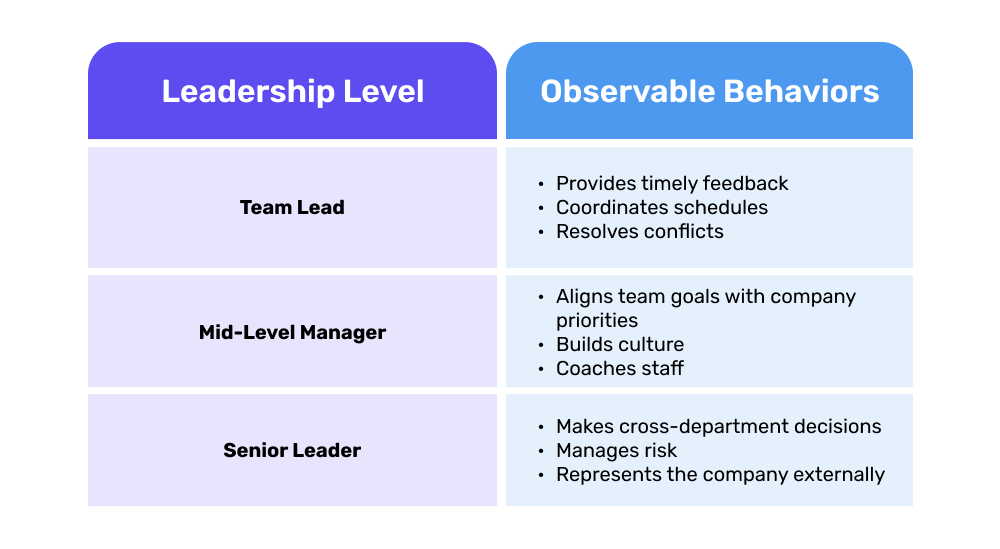
This creates a practical framework where leadership is a set of observable actions that can be tracked over time.
3: Personalizing Development
Traditional leadership programs use a same for everyone approach. AI personalizes growth by mapping each employee’s current behaviors against the framework of leadership skills.
How it works:
- Skill gap analysis compares individual performance data against benchmarks for each leadership level.
- Recommendation engines then suggest tailored growth activities, such as finance training for someone lacking budget skills or negotiation shadowing for someone needing conflict management.
- Learning pathways adjust over time, so as employees improve in one area, the focus shifts to the next most relevant skill.
With KnowledgeCity’s Training Needs Analysis (TNA) integrated, HR teams can identify each employee’s learning needs and align AI-driven development suggestions with the organization’s strategic priorities. This ensures every growth activity is relevant, measurable, and tied to building the leadership skills that matter most for the business.
4: Turning Feedback Into Continuous Progress
AI makes feedback faster and more consistent by collecting signals from multiple sources in real time.
For example:
- After a project, pulse surveys can be automatically distributed to team members to rate leadership behaviors.
- Feedback is aggregated and analyzed, removing bias by focusing on patterns rather than single opinions.
- A progress dashboard updates continuously, showing HR and managers whether employees are improving, plateauing, or needing new challenges.
This ensures leadership development is a living process rather than a once-a-year review.
5: Matching Readiness With Responsibility
Stretch assignments are one of the most powerful ways to develop leaders, but they can backfire if poorly matched. AI helps by analyzing both the skills employees already have and the skills a project demands.
- Workload data ensures that stretch projects are challenging but not overwhelming.
- Competency mapping pairs employees with assignments that strengthen weak areas while leveraging existing strengths.
- Predictive analytics estimate the likelihood of success and flag the kind of coaching support needed to make the experience productive.
This structured matching process helps employees grow without risking burnout or failure.
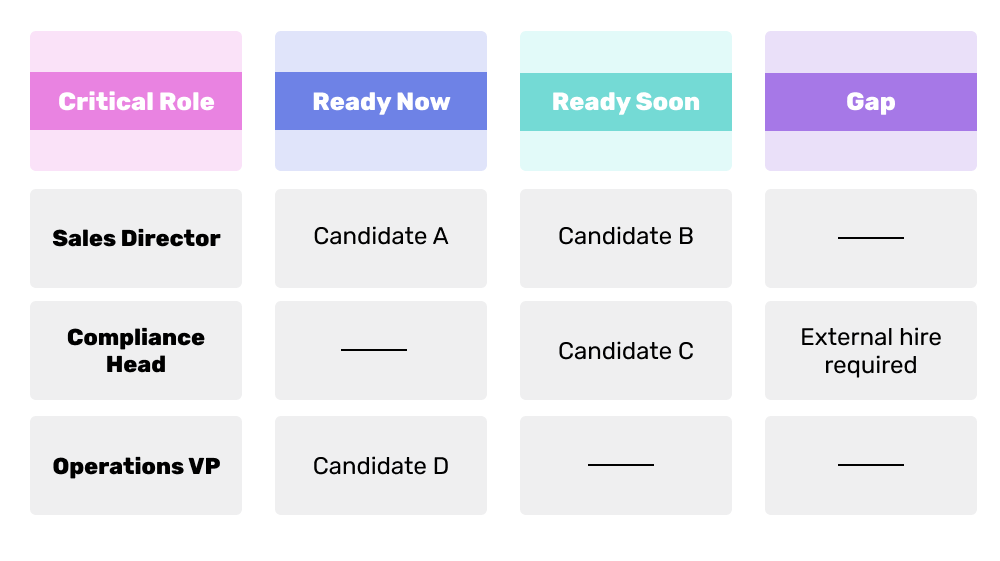
6: Making Succession Planning Predictive
Static spreadsheets often make succession planning outdated the moment they’re built. AI keeps it alive by using predictive modeling.
- It monitors employee readiness levels and updates succession charts automatically.
- It identifies gaps where no strong candidate is available and flags them early.
- It can even run what-if scenarios: for example, if two senior leaders left within six months, which roles would face the highest risk?
This turns succession planning into a forward-looking process that prepares organizations for both planned and unexpected changes.
7: Keeping the Pipeline Future-Ready
Leadership requirements evolve as business conditions shift. AI helps by connecting internal talent data with external trend data.
For example:
- If industry reports show rising demand for digital fluency, AI can assess how many current managers have completed digital training and highlight where the pipeline is thin.
- If remote leadership is becoming a priority, AI can evaluate performance data from distributed teams to identify employees already excelling in that environment.
This ensures leadership development is always aligned with future needs, not stuck in past definitions.
Bringing It All Together
A strong leadership pipeline is built step by step, not left to chance. AI supports each stage by providing better visibility into potential, clearer definitions of leadership, tailored development, real-time feedback, structured stretch assignments, predictive succession planning, and alignment with future demands.
For HR and L&D professionals, this creates smoother transitions and stronger leadership capacity. For employees, it offers fairness, transparency, and visible opportunities to grow into leadership roles.
Quick Actions You Can Take This Quarter
- Draft a behavior-based leadership framework and connect it to measurable data points.
- Use AI-driven assessments to identify high-potential employees early.
- Build a live succession map that updates automatically.
- Assign at least one targeted stretch project to every high-potential employee.
These steps start momentum now and lay the foundation for a pipeline that is resilient, fair, and ready for the future.