
As an HR or L&D professional, you understand how difficult it can be to get teams to speak up. You have likely seen meetings where everyone agrees quickly, yet decisions later reveal risks were overlooked or opportunities missed. Employees may hesitate to offer alternative opinions because they are unsure how to raise them respectfully or worry about hierarchy.
Challenge-oriented thinking equips employees to analyze ideas, question assumptions, and contribute perspectives confidently. It is not about creating conflict. It is about giving employees the insights and practice they need to raise concerns constructively, leading to stronger decisions, higher engagement, and better outcomes for the organization.
This blog provides a step-by-step approach to training teams in challenge-oriented thinking, with methods you can apply directly.
Step 1: Build Awareness and Mindset
The first step is helping employees understand why challenge-oriented thinking matters. Without this foundation, efforts to train teams can feel abstract or unnecessary.
Practical actions:
- Host workshops that explain challenge-oriented thinking and its value for decision-making and innovation.
- Share examples where challenging assumptions improved outcomes, such as preventing costly errors or identifying opportunities missed by a team that assumed consensus meant agreement was correct.
- Encourage reflection on past decisions where speaking up could have changed the result.
When employees see the connection between constructive questioning and better outcomes, they become more motivated to engage and practice these skills in daily work.
Step 2: Create a Safe Environment for Questioning
Even motivated employees may hold back if they fear negative consequences or uncertainty about expectations.
Steps to establish safety:
- Set clear norms for respectful discussion and questioning during meetings.
- Train leaders to respond positively to alternative perspectives and reinforce that constructive challenge is welcomed.
- Provide examples of phrasing challenges constructively, such as “Could we consider this approach from another angle?”
With these practices, team members feel empowered to speak up. For instance, a junior employee who notices a risk in a project timeline can raise it early, and the team can address it before it causes delays. Conversations remain solution-focused and collaborative, and employees understand that their input matters.
Step 3: Practice Through Structured Exercises
Challenge-oriented thinking improves through practice. Structured exercises create a safe space for employees to experiment with questioning ideas and exploring alternatives.
Recommended exercises:
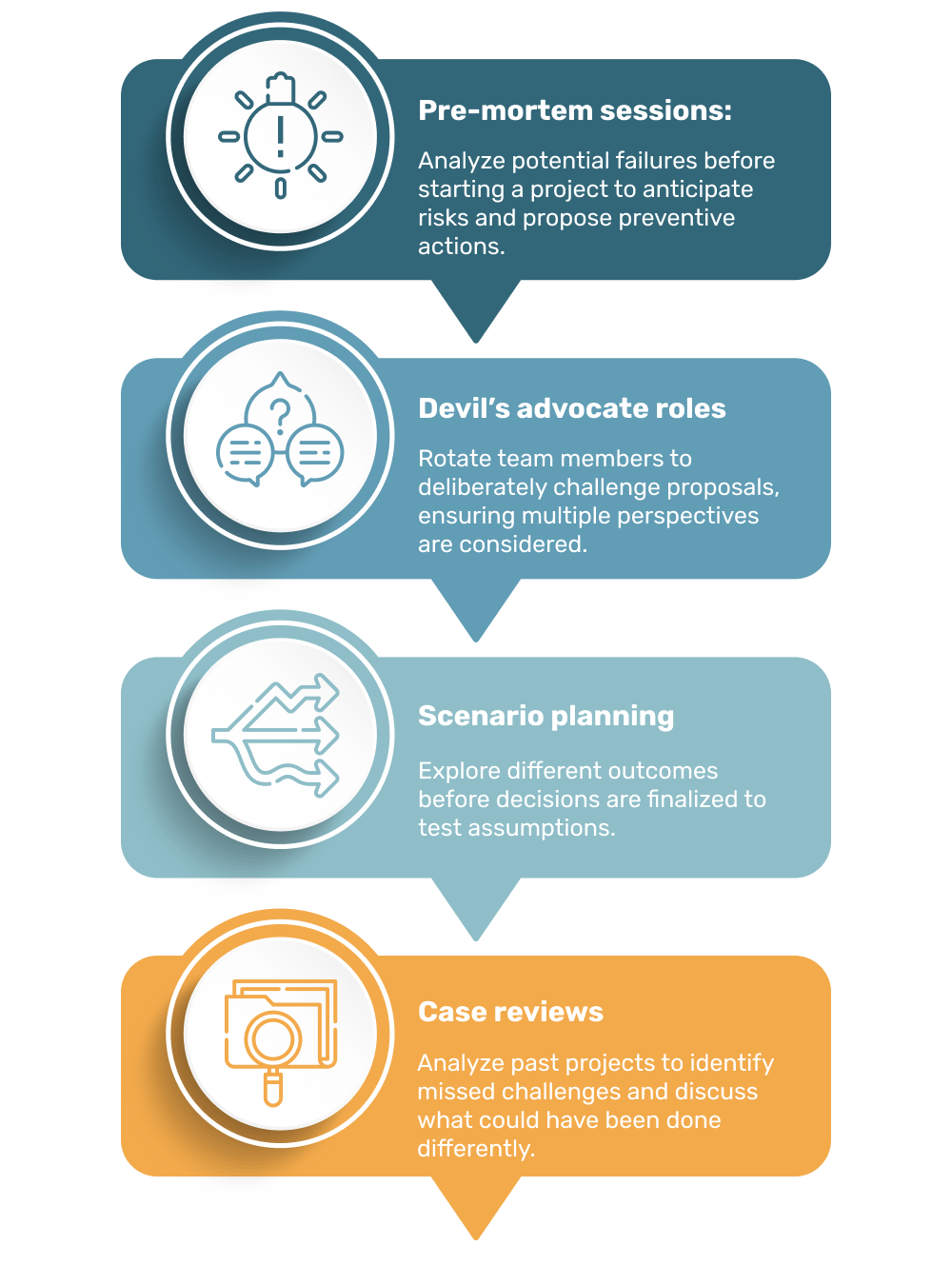
Regularly integrating these exercises into meetings or workshops allows employees to gain hands-on experience and gradually build confidence in offering constructive challenges.
Step 4: Encourage Evidence-Based Challenges
Challenges are most effective when supported by evidence, not just opinion. Employees who present data, examples, or lessons from past experience are more likely to be heard and acted upon.
Practical guidance:
- Train employees to substantiate concerns with evidence, such as metrics, reports, or prior project learnings.
- Include exercises where teams present alternative solutions with supporting facts.
- Teach employees to frame challenges in a solution-focused way, for example, “Based on last quarter’s results, could we consider a different approach to improve performance?”
When employees base challenges on evidence, discussions remain constructive. A marketing team, for instance, can review campaign metrics to suggest adjustments that improve engagement, rather than simply disagreeing with a plan.
Step 5: Reinforce and Recognize the Behavior
Training alone is not enough. To ensure long-term adoption, challenge-oriented thinking must be reinforced through recognition and leader behavior.
Actions HR and L&D professionals can take:
- Publicly acknowledge employees who provide thoughtful challenges and highlight the impact of their input.
- Include challenge-oriented contributions in performance discussions or feedback sessions.
- Encourage leaders to act on constructive suggestions, showing that these behaviors lead to meaningful outcomes.
Over time, teams begin to adopt challenge-oriented thinking as a natural part of their workflow. Employees understand that constructive challenges are valued, making them more likely to participate consistently and confidently.
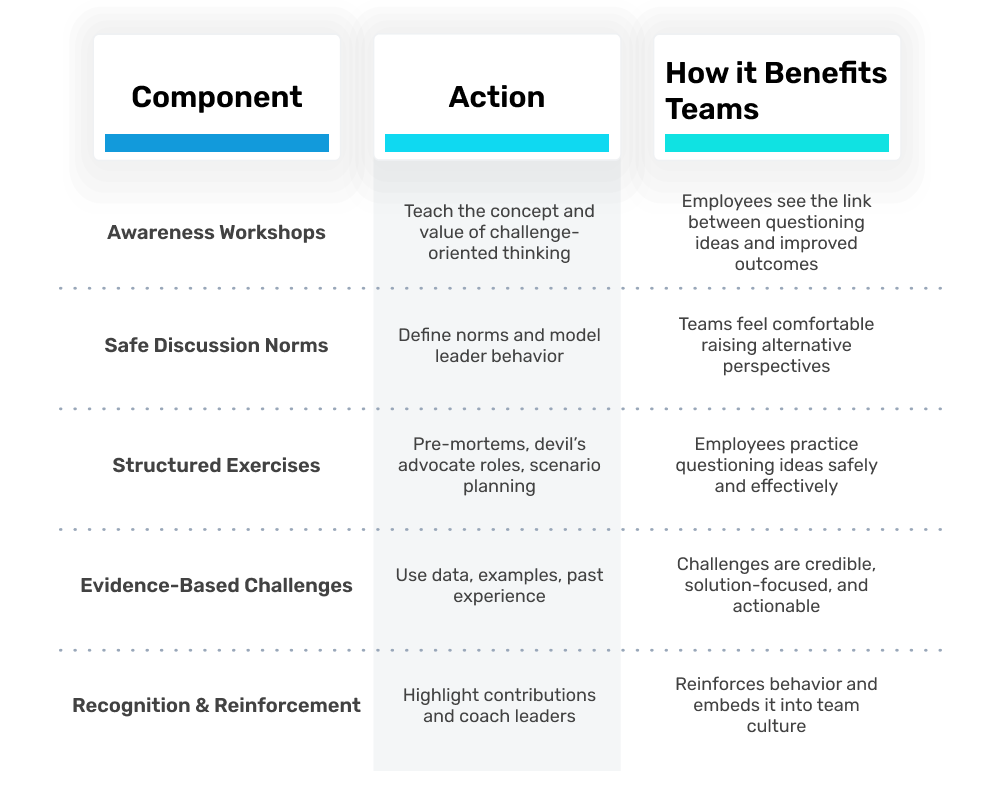
Challenge-Oriented Thinking Training Framework
Step 6: Integrate Challenge-Oriented Thinking Into Daily Work
To make the mindset sustainable, it must be part of everyday workflows:
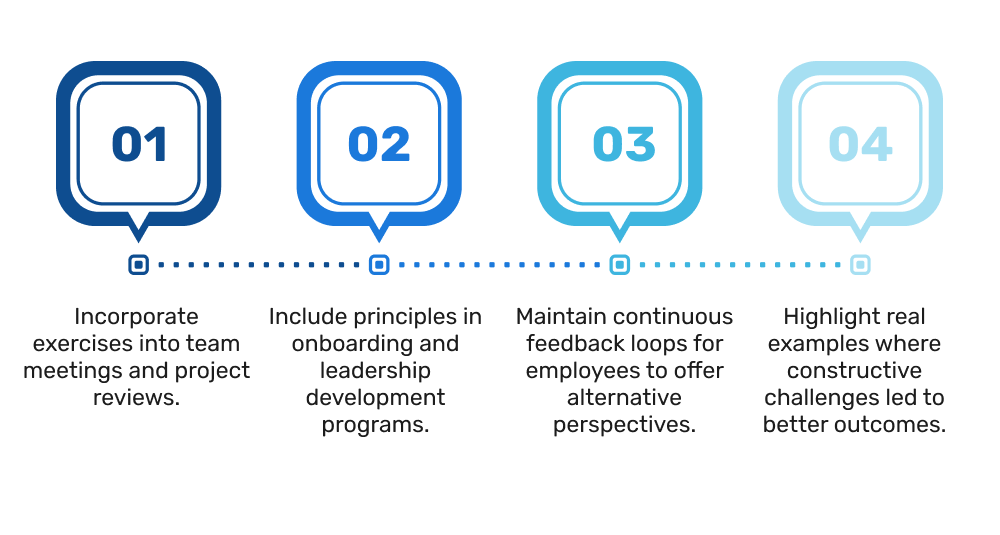
When these practices are integrated into daily work, teams begin to anticipate risks, explore alternatives, and make confident decisions consistently. Challenge-oriented thinking becomes part of the culture, not just a training exercise.
By combining awareness, safe environments, structured practice, evidence-based challenges, reinforcement, and workflow integration, HR and L&D professionals can train teams to approach work thoughtfully, confidently, and proactively. Teams that adopt this mindset are better equipped to prevent mistakes, identify opportunities, and make stronger decisions, benefiting both the employees and the organization.
Empower Your Teams with KnowledgeCity – The Best Employee Training Platform in the USA
KnowledgeCity’s expertly curated learning library provides comprehensive courses and resources to support HR and L&D professionals in developing challenge-oriented thinking across teams. Our library covers practical skills, critical thinking exercises, and real-world scenarios, giving employees the knowledge and confidence they need to contribute effectively. With KnowledgeCity, you can ensure your workforce is prepared to raise constructive challenges, make informed decisions, and drive better outcomes for your organization.