
Every HR and L&D professional wants to see proof that development programs are working. Whether it’s a leadership track, a technical upskilling initiative, or a company-wide learning rollout, the question is always the same: Is this actually helping our people grow?
Most teams rely on traditional data to answer that question. They look at training completion rates, post-program assessments, or annual performance reviews. Those numbers are useful, but they only reflect what has already happened. By the time you see the results, the moment to influence them has already passed.
This is why a growing number of HR teams are shifting toward predictive measurement. Instead of waiting to evaluate outcomes at the end, they track early signals that show whether development efforts are on the right path. These are known as leading indicators. The metrics that come afterward, confirming the results, are lagging indicators.
When both are used together, HR and L&D professionals gain what most development programs lack: visibility before it’s too late.
Understanding the Difference Between Leading and Lagging Indicators
The distinction between the two is simple in theory but powerful in practice.
- Leading indicators are early signs that help you predict success. They are observable, short-term actions or behaviors that signal whether employees are engaging and progressing as expected.
- Lagging indicators measure outcomes after the fact. They confirm whether the desired results were achieved, such as improved performance, higher retention, or skill proficiency.
In the context of employee development, leading indicators show whether the learning process is working, while lagging indicators show whether the results were sustained.
For example, when you track how quickly employees start a new course or how often managers check in after training, you are monitoring leading indicators. When you later review performance reviews or promotion rates, you are assessing lagging ones.
Both have value, but they serve different purposes.
Why Many Development Programs Struggle with the Wrong Metrics
Many HR and L&D teams rely heavily on lagging indicators because they are familiar and easy to report. They appear in dashboards, annual reports, and executive briefings. However, by the time lagging data becomes available, there’s no opportunity to correct the course.
Imagine launching a major skills development program, only to realize six months later that completion rates were high but on-the-job application was low. At that point, the insight is too late to help that cohort succeed.
This is why development measurement needs a more proactive structure. By identifying the right leading indicators, HR teams can adjust programs early, guide managers to support their teams better, and prevent underperformance before it shows up in the final results.
The shift from reactive to predictive measurement changes the role of HR. It allows HR professionals to move from reporting on learning to managing its progress.
Examples of Leading Indicators in Employee Development
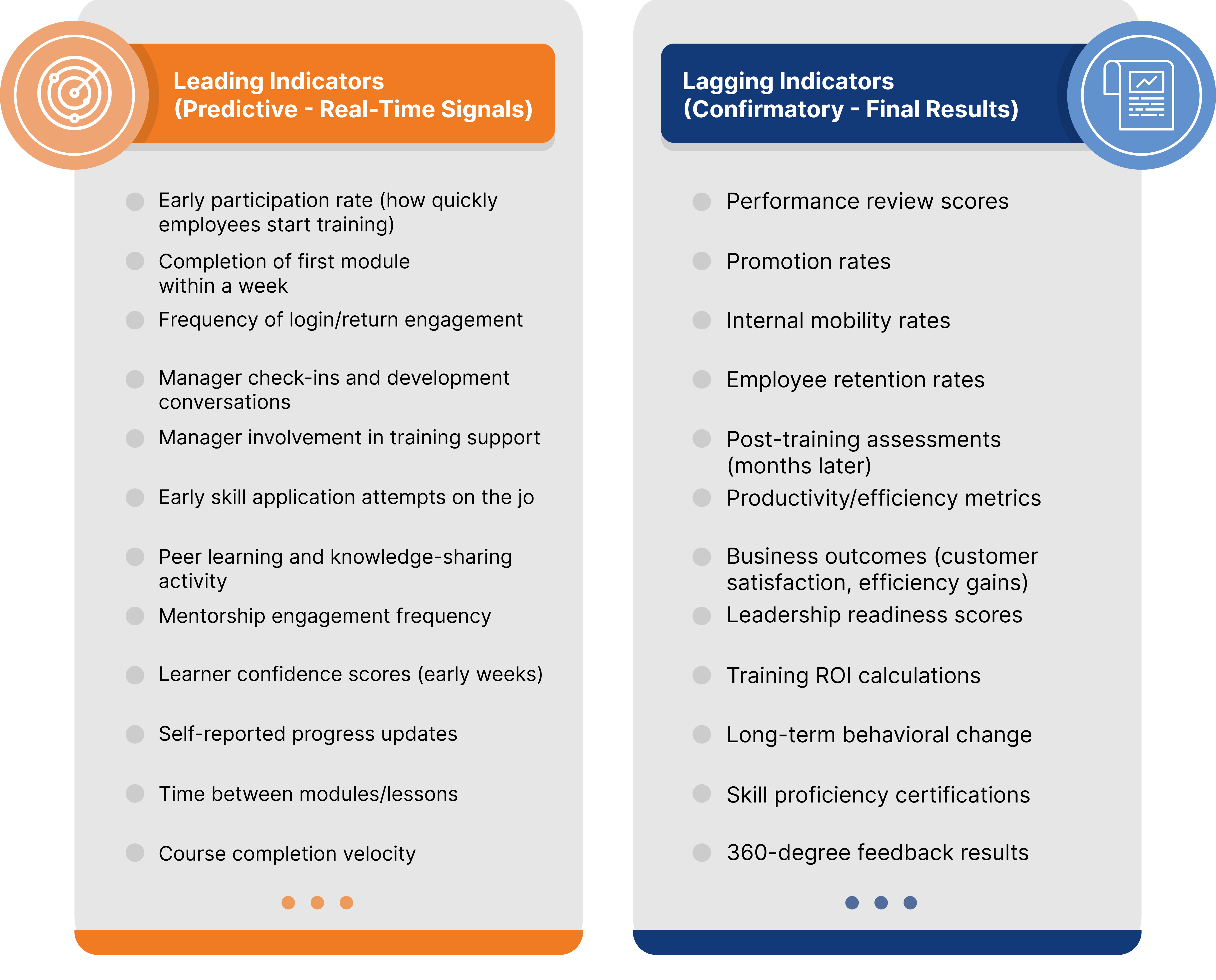
Leading indicators help HR understand what’s happening in real time. They highlight progress, momentum, and engagement while programs are still active. Here are examples of useful leading indicators for employee development:
1. Early Participation and Engagement
How quickly employees begin assigned training after enrollment, how many complete the first module within a week, and how consistently they return are early signs of program health. If engagement drops early, it usually predicts lower completion and retention later.
2. Manager Support and Involvement
When managers discuss learning goals with their teams or provide space for skill application, it signals that development is becoming part of the workflow. Tracking how often these interactions occur helps identify teams where learning is supported versus teams where it is not.
3. Skill Application Attempts
Early attempts to apply new skills on the job, even small ones, often predict long-term success. This can be captured through employee self-reports, manager feedback, or project tracking. A strong application rate early in the process often leads to measurable improvement later.
4. Peer Learning and Collaboration
The frequency of peer discussions, mentorship engagement, or knowledge sharing in team channels shows how learning is spreading organically. When employees start teaching or helping others, it indicates that learning is sticking.
5. Confidence and Perception
Tracking learner confidence within the first few weeks can reveal readiness to apply new skills. Low confidence scores early on can signal where additional coaching or resources are needed.
These indicators don’t just measure participation. They measure momentum.
How Lagging Indicators Validate the Outcome
Lagging indicators complete the picture. They confirm whether your early signals actually led to meaningful outcomes. Common lagging indicators for development programs include:
- Changes in employee performance or productivity scores
- Improvements in promotion or internal mobility rates
- Retention rates in key roles or cohorts
- Post-training assessments conducted months after completion
- Business outcomes linked to development, such as customer satisfaction or efficiency gains
While these are essential for proving ROI, they should not stand alone. A lagging result without a leading signal offers no explanation. Combining both provides not only proof of success but also insight into what caused it.
For example, if leadership readiness scores rise six months after a program, and your leading data shows high early engagement and consistent manager check-ins, you can confidently link cause and effect.
Here’s a quick overview to help you identify and track both types of indicators:
How to Build a Predictive Measurement Approach
To make this practical, HR teams can follow a simple structure that connects early signals with long-term outcomes.
Step 1: Define the Final Outcome
Start by identifying what success looks like. This might be improved leadership effectiveness, stronger communication skills, or higher retention in specific roles. These will serve as your lagging indicators.
Step 2: Identify the Behaviors That Lead There
Once the goal is defined, determine what short-term actions would predict that success. For example, if your goal is leadership improvement, early participation in coaching sessions or regular manager discussions could be strong leading indicators.
Step 3: Set Measurable Targets
Set realistic thresholds for both types of indicators. For instance, 80% of participants should complete the first learning module within the first week, or every manager should hold at least one development check-in within the first month.
Step 4: Monitor Progress Frequently
Review leading indicators weekly or monthly, not quarterly. Use the data to make small, timely adjustments. If engagement falls, find out why. If skill application stalls, involve managers earlier.
Step 5: Connect Data and Review Correlation
Once lagging outcomes are available, compare them to your leading indicators. This helps confirm which early actions had the most influence. Over time, your measurement model becomes more accurate and predictive.
How This Approach Changes HR’s Role
When HR uses both leading and lagging indicators effectively, its role evolves from reporting to guiding. Instead of waiting for annual results, HR teams can anticipate trends, address challenges early, and show leadership how development contributes to business outcomes in real time.
This approach also strengthens HR’s relationship with managers. By sharing early signals, HR helps them support employees better. Managers stop viewing learning as a formality and start seeing it as an active part of performance improvement.
For employees, it changes the experience too. When feedback, support, and progress tracking happen continuously, learning feels purposeful. It shows employees that development is being taken seriously, not as a one-time event but as an ongoing process.
KnowledgeCity: The Best Employee Training Platform for Smarter Workforce Development
Employee development is most effective when HR can see what’s working while it’s still happening, not months later. Leading indicators provide that visibility. Lagging indicators validate the result. When both are tracked together, development programs become measurable, adjustable, and truly impactful.
That’s where KnowledgeCity, the best employee training platform in the USA, helps organizations take the lead. With an AI-powered LMS and a learning library designed by US-based university professors and industry experts, KnowledgeCity enables HR and L&D teams to track progress in real time, personalize learning, and train employees with the highest-quality content to strengthen skills and improve performance across the organization.