
There is a new kind of team member showing up in workplaces around the world. You cannot see them, greet them in the hallway, or invite them to lunch. But they are already part of your daily work. They answer questions, schedule meetings, summarize reports, and recommend learning paths.
They are AI agents, chatbots, and digital assistants, the invisible workforce quietly powering the modern organization. These systems handle administrative, analytical, and even creative tasks with precision and speed. They automate what was once manual, guide employees through learning journeys, and interpret data faster than any human could.
They are invisible not because they are absent, but because their presence blends seamlessly into the background. They support every function without demanding space, time, or recognition. The invisible workforce is not coming; it is already here. Let’s explore it in this blog.
AI as the New Coworker
For HR and L&D professionals, this marks a turning point. Workforce composition can no longer be viewed through the traditional lens of full-time, part-time, and gig workers. It now includes digital workers who perform consistent, measurable functions alongside humans.
AI has entered the realm of real collaboration.
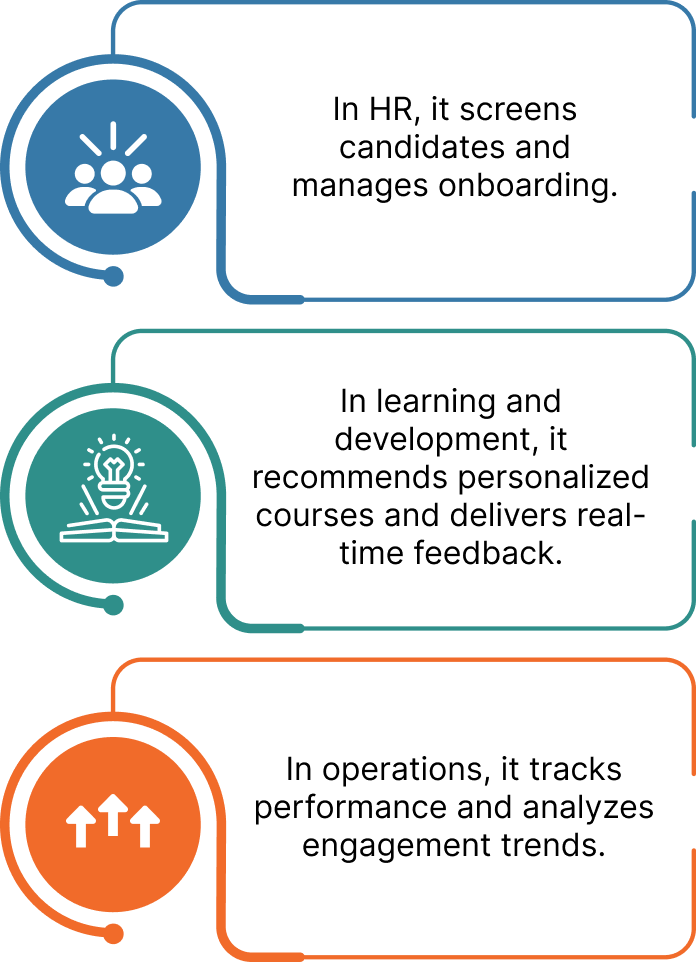
This shift changes the central question for HR leaders. It is no longer “How can we use AI?” but “How can we work with AI?”
HR and L&D teams must now act as orchestrators of a hybrid workforce where people and intelligent systems work side by side. Building this balance demands new readiness across technical, emotional, and cultural dimensions.
The Challenges Ahead for HR and L&D Professionals
The invisible workforce brings extraordinary potential, but also complexity. The way people think about work, skills, and trust will need to evolve.
1. Training employees to collaborate with AI
Most employees were trained to use tools, not to work alongside intelligent systems. They must learn how to guide AI, interpret its outputs, and recognize when to rely on human judgment.
2. Redefining roles and competencies
As AI automates routine tasks, human roles shift toward creativity, problem-solving, and relationship-building. HR must redefine job descriptions and competency models to reflect these changes.
3. Managing trust and transparency
AI systems make recommendations that influence real decisions, from hiring to learning to performance. Employees will only trust these systems if they are transparent and fair. HR must ensure that AI is designed and deployed with accountability.
These are not just operational questions. They go to the heart of what it means to belong in a team. When part of the team is invisible, HR and L&D must build new ways for people to feel confident, valued, and in control.
Building Capabilities for a Human + AI Workforce
Capability building is where transformation becomes real. Employees need more than new skills and must develop new ways of thinking about work itself.
The foundation is AI literacy. Every employee should understand what AI is, how it learns, and how its insights should be interpreted. When people understand AI, they stop seeing it as a black box and start seeing it as a partner.
Next comes workflow integration. L&D teams can help employees map exactly how AI fits into their roles. For example, when an AI assistant creates a first draft of a report, employees should know how to refine and verify it. When an AI tool suggests a learning path, employees should learn how to give feedback to make it smarter.
The final piece is ethical awareness. AI’s power demands responsibility. Employees should know how to spot bias, protect data, and maintain human oversight. These skills build trust in both directions. People trust the system, and the system reflects the values of the organization.
When these capabilities come together, people stop competing with AI and start collaborating with it. They begin to see it not as a replacement, but as a reliable teammate that amplifies their own strengths.
The Emotional Side of Working with Digital Coworkers
Technology may transform work, but emotion defines how that transformation feels. For many employees, the arrival of AI coworkers creates unease. If a machine can analyze, predict, or write, what space is left for the human contribution?
This is where HR and L&D leadership become deeply human.
Trust must come first. Employees need to see that AI is introduced thoughtfully, not recklessly. HR can build trust by explaining how AI systems are used, what data they access, and how decisions are reviewed by humans. Transparency turns uncertainty into understanding.
Psychological safety is equally important. Employees should be encouraged to question AI results, express doubts, and share experiences without fear of judgment. When people feel safe to challenge AI, collaboration becomes more accurate and ethical.
Finally, there is purpose. AI should be positioned as a tool that supports growth, not surveillance. When employees see that AI frees them from repetitive tasks and gives them time for creativity, curiosity replaces anxiety.
Culture holds all of this together. An organization’s tone toward AI is set by its leaders. If leaders model openness, humility, and continuous learning, the entire workforce follows. A culture that values both intelligence and empathy will always adapt faster than one that values technology alone.
Creating a Playbook for the Invisible Workforce
To move from awareness to action, HR and L&D teams can develop an Invisible Workforce Playbook. This framework helps organizations manage and empower a hybrid workforce where humans and intelligent systems work together.
1. Audit the Present
Start with visibility. Identify where AI already operates in your organization. Document its functions in recruitment, learning, analytics, or support. Understanding where AI lives is the first step toward managing it.
2. Build Awareness and Literacy
Develop simple, practical learning modules that explain how AI works and how employees can collaborate with it. Avoid technical overload. Focus on how AI impacts decisions, creativity, and communication.
3. Map Human-AI Workflows
For every function, define the boundaries. Which tasks are AI-driven? Which require human judgment?
Clear maps prevent overlap and confusion. They also make accountability transparent.
4. Redefine Learning for Hybrid Teams
Integrate AI into learning journeys. Use AI tutors or assistants to personalize learning, track progress, and suggest skills for development. But keep human mentoring and coaching central. AI can guide, but only people can inspire.
5. Measure the New Metrics of Success
Look beyond productivity metrics. Track how AI improves employee confidence, collaboration quality, and learning outcomes. Success in a hybrid workforce is about synergy, not speed.
6. Keep the Dialogue Alive
AI will keep evolving, and so must the conversation. Collect feedback, address concerns, and celebrate successes. Treat the integration of AI as an ongoing dialogue rather than a one-time project.
The Future Workforce Is Already Here
The invisible workforce is not a vision of tomorrow. It is already here, shaping how teams communicate, learn, and perform. Preparing teams for this new reality begins with learning. As AI becomes part of everyday work, organizations need training that builds both confidence and capability.
KnowledgeCity offers a complete learning platform that helps HR and L&D teams equip their workforce with the skills needed for the AI era. Our courses strengthen AI literacy, enhance critical thinking, and develop the human capabilities that make collaboration with intelligent systems successful. With the right learning foundation, employees can move from adapting to AI to truly advancing with it.